
Tools / Stacking
Toolbar tool
Stacking
Turn a folder of raw sub-exposures into one clean master — graded, aligned, and integrated. No separate stacking app needed.
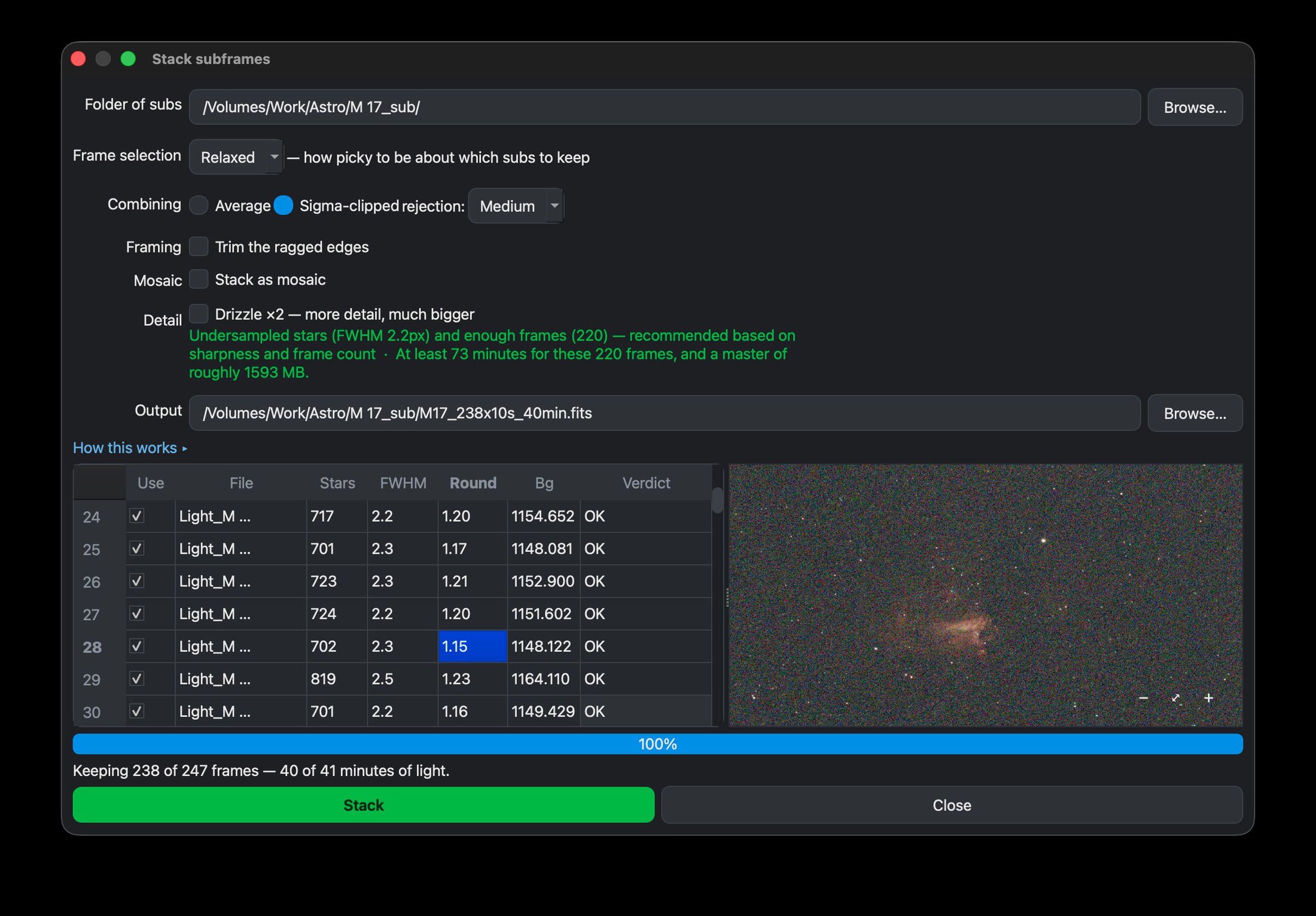
What it does
Turns a folder of individual sub-exposures into a single clean master. It grades every frame, measuring star count, sharpness (FWHM), star shape and the structure of the background, and flags the ones hurt by cloud, wind or soft focus — or by something large in the way, a roof or a tree the scope has drifted into. It rejects the duds, registers (aligns) the rest — handling the field rotation an alt-az mount like the Seestar introduces — and integrates them into one image.
How to use it
- Click Stack in the toolbar and choose your folder of subs.
- Pick a Strictness (Relaxed / Normal / Strict) — how picky the automatic frame selection is.
- Choose an Integration method: Average, or Sigma-clipped (with a κ of Low / Medium / High) to reject satellites, planes and hot pixels.
- Let it grade, review the table — rejects are flagged, and you can override any frame by hand — then Stack. The finished master loads straight into the editor.
If you already have a stacked master — from the Seestar app, say — you can skip stacking entirely and just Open Image.
When you do not need this toolTips
More subs mean a cleaner master with less noise. Sigma-clipped integration is the safe default — it rejects the odd satellite trail automatically.